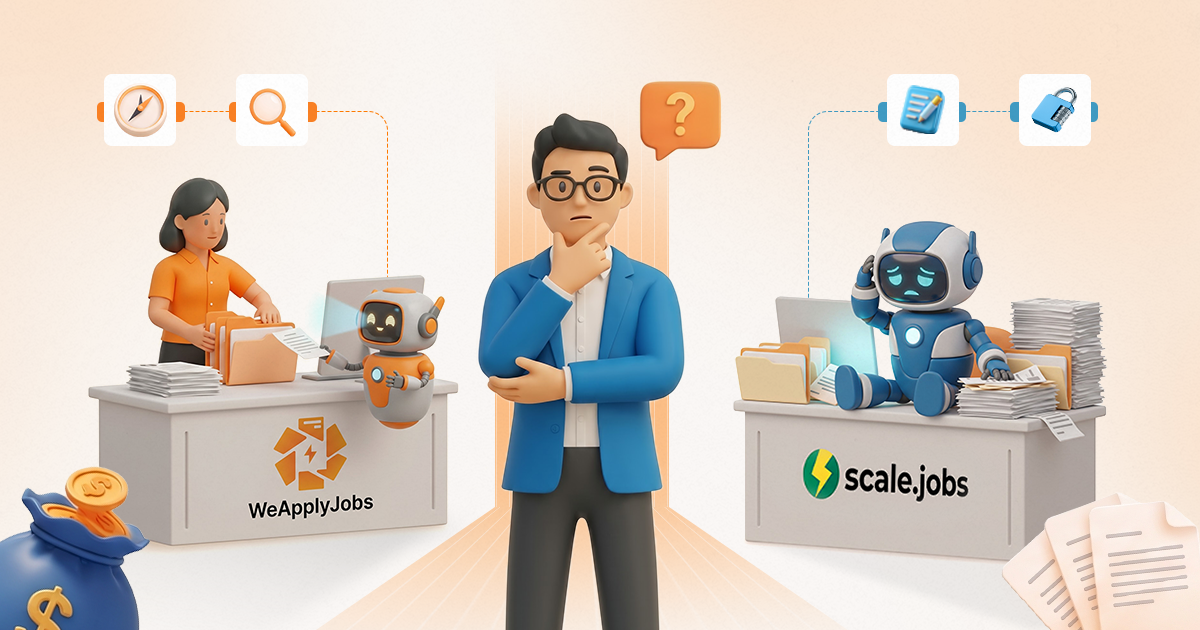

AI auto apply vs human job application service is really a question about who makes the decisions during your applications. Auto-apply tools use software to find or submit jobs from saved criteria. Human application services assign people to some or all of that work.
Neither model is automatically accurate or relevant. A good automated workflow can be better than a careless human process. A strong human service can handle context and exceptions that are difficult to capture in a few filters. The useful comparison is what happens between finding the job and pressing submit.
Autofill and auto apply are not the same thing
Autofill helps populate a form you are actively completing. Auto apply can search for jobs and submit applications with less involvement after you configure your profile and preferences.
That difference matters. If you still want to review every role and answer, an autofill tool may remove enough repetitive work without giving software full control over submissions.
If you want the search to keep running while you focus on interviews or your current job, you are comparing automated submission tools with human application services.
AI auto apply vs human application service at a glance
| Decision point | AI-led workflow | Human-assisted workflow |
|---|---|---|
| Job selection | Driven by filters, matching logic, and saved preferences | Driven by your brief plus human review |
| Routine form fields | Pulled from saved profile data | Completed from approved candidate information |
| Written answers | May be generated automatically | Can be drafted, reviewed, or escalated to you |
| Unexpected questions | Needs a reliable pause or review setting | Needs a clear rule for asking you |
| Corrections | Depends on edit controls and support | Depends on team accountability and quality checks |
| Candidate effort | Setup, monitoring, review, and exception handling | Onboarding, clarifications, and oversight |
| Best fit | Clearly defined searches with consistent answers | Searches where context and judgment matter |
These are general workflow differences, not a guarantee that every product in one category behaves the same way.
When AI auto apply can be enough
Automation works best when your target roles are narrow and predictable. If you are applying to the same type of role, in the same locations, with the same basic screening answers, software has fewer judgment calls to make.
Start with a small test. Check whether location filters behave as expected, seniority matches your experience, company exclusions work, and written answers stay within the facts you supplied.
Measure how much time you still spend supervising the tool. If you review nearly every match, fix answers constantly, and monitor failed submissions every day, the automation may not be removing as much work as you expected.
When a human job application service makes more sense
Human assistance becomes more useful when the search has context that is difficult to reduce to a few settings. Examples include a career change, several acceptable role families, complex experience, narrow location rules, or jobs where written questions vary a lot.
A human service can also be the better fit when your real problem is consistency. You may know exactly what to do but struggle to keep applying every day while working, interviewing, studying, or dealing with a layoff.
Human involvement only adds value when the team follows your instructions. Ask who checks the applications, what happens when someone is unsure, and how corrections are handled.
Use the same quality test for both
Take a sample of completed applications and compare each one with your original criteria. Check the role, location, level, company, factual accuracy, resume version, written answers, and proof of submission.
Separate system errors from instructions you forgot to give. A wrong location may mean your filter needs work. An invented claim is a quality-control problem. A duplicate application means the tracking process failed.
Increasing volume does not fix a weak process. It only repeats it faster.
Compare the work left on your plate
Price is only part of the decision. Include the time you spend setting up profiles, reviewing jobs, answering questions, correcting submissions, and keeping records.
If you enjoy choosing roles and only hate typing the same information, a lightweight tool may be enough. If the entire application routine keeps slipping, a tool that still needs daily supervision may not solve the problem.
WeApplyJobs uses human specialists for managed applications. The application work stays with the team while the candidate keeps visibility through the dashboard. Managed plans are one-time packages, not monthly subscriptions.
Frequently asked questions
Do employers automatically reject AI-assisted applications?
There is no universal rule across employers. Follow the instructions on each application and make sure every answer is accurate. The bigger risk is poor fit, generic responses, or incorrect information.
Can AI tailor a resume without making things up?
AI can help rewrite and re-emphasize existing experience, but you should verify the output. Tailoring should not create credentials, achievements, employers, or results that are not true.
Is a human application service always better than automation?
No. The better choice depends on the workflow. A careful automation setup can outperform a poorly managed human process, and a strong human service can handle exceptions that automation struggles with.
What should I test before paying?
Check role relevance, answer accuracy, exception handling, visibility, and how much work still stays with you. Those factors matter more than the advertised daily application limit.
If you want application execution without another automation tool to supervise, compare WeApplyJobs' human-managed plans.